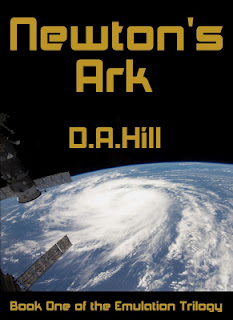
Serialized Novels

Releasing novels in serial form seems to be making a bit of a comeback. Amazon for one is pushing the concept hard including re-releasing various works by Charles Dickens like Oliver Twist in their original serial form.
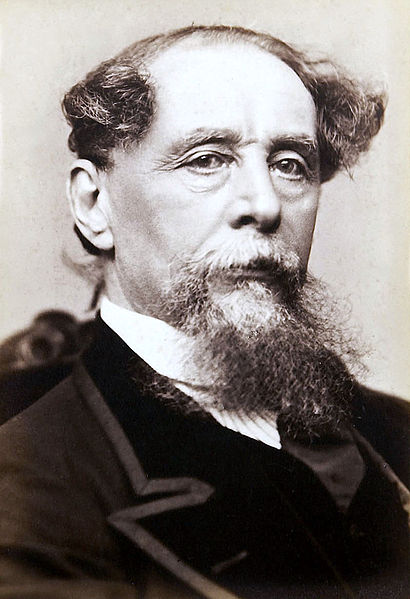
I picked that example because it highlights the issue I can’t get my head around. Why would you want to receive a novel that has been completed for over one hundred and fifty years piecemeal?

But what about a work in progress? Wouldn’t it be nice to receive each chapter as it is completed? Sure, but that assumes the writing process is linear. That has definitely not been my experience so far. I’ve written one hundred and sixty pages of Faraday’s Mine, but they are not even close to consecutive. It would be more like pages 1 – 50, 75-100, 130 – 140, 200 – 275. And there is lots of going back and reworking the story as I go along.

Which leads me to my question. I know many people who have read Newton’s Ark are waiting impatiently to see what happens next. Is there any interest in seeing Faraday’s Mine released as each chapter is completed, even knowing that they may change (radically) before it is done?
Researching Book Locations

With the wonders of Wikipedia and Google Maps and especially Google Earth it has been possible to do a great deal of research on locations for my stories without even leaving the comfort of my own home. Even so, there’s no substitute for actually visiting a place to get the feel for it. Fortunately almost all of the locations in Newton’s Ark were places I had visited. The exception was the location in north-east Colorado. I’ve been to the general area, so I know what the rolling plains out there look and feel like, but I’ve never been inside that missile silo or any other.

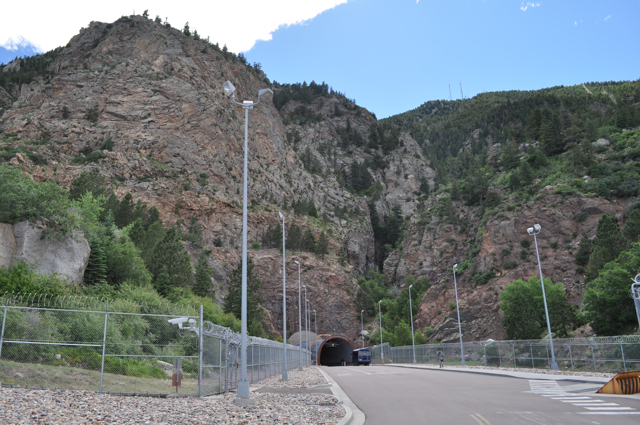
A big part of Faraday’s Mine, the second book in the Emulation Trilogy, will be set in and around Colorado Springs, specifically inside the Cheyenne Mountain Complex.

Despite the fact that Colorado Springs is only four and a half hours from Steamboat, I had never been there. So this weekend I remedied that. Unfortunately there’s no way to get inside (at least if you want to live to tell the tale), but I did get quite close – housing estates now come within two hundred yards of the entrance (good thing the Cold War is over because this would have been the first place the Soviets would nuke) – and I did get a great sense of  the surrounding area, which will also be important to the story.

Writing Tools

One of the challenges I faced in writing Newton’s Ark was tracking several parallel story lines until such time as they all came together towards the end of the book. At the time the only tool I had at my disposal was Microsoft Word and its Outline view. It got the job done but it was a struggle, like driving a screw with pliers. You can do it, but why would you when there’s this thing called a screwdriver?

Soon after I began on the sequel, Faraday’s Mine, I realized I was going to have the same problem, only more so. Not only did I need to keep the story line straight, but it had to be consistent with what had already happened in the first book. And I wanted to raise the intrigue a level, making the web even more tangled.

Fortunately I discovered a wonderful program called Scrivener which allows me to organize the book into chapters and scenes using the metaphor of index cards on a cork board. Now I can easily create the structure of the story and then change it on the fly. I can attach notes to each scene to remind myself what I plan to write as well as attaching keywords for characters and locations to each of the scenes so I can see who is doing what to whom and where.

Here’s a look at one of the chapters. If you look real close you might just be able to figure out what is going to happen (warning spoilers – assuming I don’t change it or I’m not just playing with you).

It has turned out to be one of those tools I didn’t know I needed until I found it. Now I couldn’t imagine writing another novel without it.

This post brought to you by author, D.A.Hill.

Fusion Reactors

As I have mentioned previously I was very conscious in writing Newton’s Ark to keep the science as real as possible. The most speculative technology I included was probably the micro fusion reactor – a small, highly portable fusion reactor that could power a satellite for decades.

This technology requires us to find a way to build a self-sustaining fusion reaction that produces positive net energy. And then you have to miniaturize it – I’m going to ignore that challenge assuming we can solve the main problem.

This technology has been a decade away for the past sixty years. Will we ever solve this problem? Who knows. It may really be a only decade away, it may be another sixty years away or it may never happen. It’s hard to extrapolate from the experience to date. There has been some progress but not enough to be completely confident that the fundamental challenge can be overcome.

It is still an active area of research though. In fact I recently received an assignment to design a biometric security system (iris recognition) for an experimental fusion reactor facility!

This post brought to you by author of Newton’s Ark, D.A. Hill.

More Sci Fi Keeping it Real

I posted recently on keeping the sci fi real in my first novel Newton’s Ark.

I just ran across this article about stopping an asteriod specifically debunking the scenario presented in the movie Armageddon of using a nuke to split it in half.

Here’s a relevant passage from my book:

“Despite all the holo-movies you might have seen where they destroy the asteroid before it hits the Earth and everyone lives happily ever after, it isn’t possible with the technology and time we have available. To nudge the asteroid off course we have to hit it far enough out that we would need to launch now. Problem is we don’t have anything with the range and payload required….”

“Can’t we just nuke the damn thing when it gets closer to Earth?”

“Yes sir we can, but we risk turning a single very large asteroid into multiple asteroids, each still plenty big enough to wipe out a large city. Better to have only one object to track and to limit the impact to a single location.”

I think this quote from the article nicely captures my philosophy:

…fiction is all about the make-believe. But good science can make for a more plausible narrative, making it easier to suspend disbelief.

This post brought to you by author D.A. Hill.

Keeping Sci Fi Real

One of the things I set out to do when writing Newton’s Ark, was to keep the science part of the science fiction plausible, by basing the technology of the future either on already emerging technologies or at least on plausible projections of current technology trends.

This article on taking control of drones by spoofing GPS signals is a good example.

Here’s the relevant section in the book:

 “The early drones worked exactly that way, Major. They were vulnerable; if communication is disrupted the drone is pilot-less. Worse still, if the signal is intercepted it is possible for a hostile force to take control of the drone. Back as far as 2012 the Iranians captured what was then one of our most advanced drones by spoofing a GPS signal. They convinced the drone that it was landing back at its base in Turkey when it was really landing in Teheran. Incidents like that were the impetus for the EM program.”

This post brought to you by author D.A. Hill

Book Availability Update

Newton’s Ark is now available via Smashwords in EPUB format suitable for iBooks, the Nook and the Sony eReader.

https://www.smashwords.com/books/view/179199

It is now available via iTunes, Barnes and Noble and the Sony Store.

This post brought to you by author  D.A. Hill, author of Newton’s Ark.

Paper Back Now Available in Europe

The paperback version of Newton’s Ark should be available via Amazon in Europe from tomorrow for £5.99 or €6.99.

US pricing for the paperback is $7.99.

If you’re really worried about price though, the Kindle edition is a bargain at $2.99 (or the equivalent in pounds or euros). Interestingly, I make a bigger royalty on a $2.99 kindle edition than I do on a $7.99 paperback.

That makes it hard to see how traditional publishers can justify asking almost as much for the Kindle version (and sometimes more!) than for the hard copy. e-books should be considerably cheaper, not only because they are much cheaper to produce and distribute, but also because they are more restrictive (you can only lend them once ever, if at all, and you can’t resell them) which ought to mean more sales. The disruption of the publishing market has really only just begun.

Plant our Brains in Robots

If you find the ideas in this article from Wired Magazine titled Russian Mogul’s Plan: Plant our Brains in Robots interesting, then you should read my book Newton’s Ark (and the forthcoming sequels).

I’m attempting to explore similar concepts through fiction, with the goal of trying to understand how these sorts of technological developments might affect the human experience. My view is that when confronted with ideas this radical, stories are the best way to explore the possible implications. Otherwise it’s all too abstract, all to clinical, all too remote, and therefore all too easy to ignore, at least until it actually begins to happen and we’re totally unprepared.

This post brought to you by author D.A. Hill

Book Pricing in Australia

I am in Australia visiting family and while I’m here I’ve been into a few book stores. Shocked is the only word I can use to describe my reaction to the price of books here. Take, for example, Caleb’s Crossing, the latest book by Geraldine Brooks (I haven’t read it but I loved People of the Book). It is available on Amazon.com for $10.88 in paperback and $16.17 in hardback; it’s nearly $25 (in paperback!) in the book store here.

For all Australian readers, I would say if you don’t have a Kindle buy one. Now. Forget about walking the dog. Forget about feeding the kids. Jump on Amazon.com now and buy a Kindle. Caleb’s Crossing and lots of other great books are only $9.99 on Kindle (and even the ‘expensive’ books are $12.99). Not to mention there are lots of books like mine available at the ridiculously cheap price of $2.99.

This post brought to you by author D.A. Hill