Front Range Retail Outlet

From Monday November 5, the paperback edition of Newton’s Ark will be available from the Brainfood Bookstore in Longmont just north of Denver (332 Main Street #C2). If you are in the area check it out and if not, take a minute to like their Facebook page.

They were quite excited to carry my book since a large part of it is set in Colorado and are really looking forward to Faraday’s Mine since much of it is set quite close to Longmont.

Post-Apocalyptic Worlds

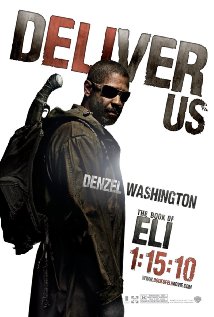
I watched the movie The Book of Eli recently. I would recommend it. Apart from a great performance from Denzel Washington (of course) it has an interesting premise with a bit of a Sixth Sense twist at the end (although not as well carried off).

What I found interesting was its portrayal of the post-apocalyptic world. The film only hints at what happened but it must have been bad because the world is desolate and barely habitable. I thought the technique the director used to convey this was very well done – the colors are so subdued that the film almost looks like it was shot in black and white. In many scenes the only color is the brown of Denzel’s face.

I’ve been considering the portrayal of post-apocalyptic worlds in books and film recently because my next book Faraday’s Mine will be set in a post-apocalyptic world (the apocalypse arrives in Newton’s Ark but you don’t really get to see what the world is like afterwards). But it is a very different post-apocalyptic world from that portrayed in The Book of Eli or many other stories. The events in Newton’s Ark cause some temporary climate effects, but the ecosystem soon recovers. Imagine a lush world in which robots and other automated systems keep all the infrastructure as good as new, but maybe there’s nobody around to enjoy it…

Serialized Novels

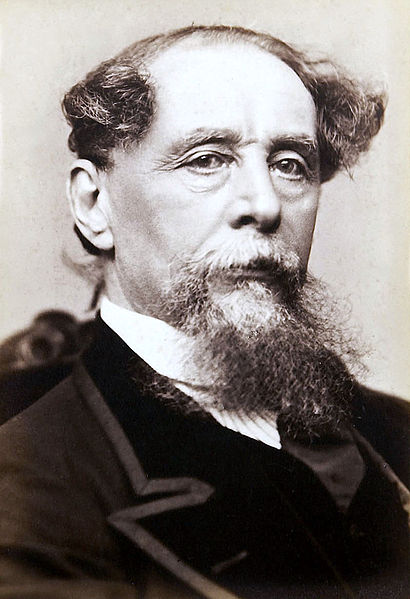
Releasing novels in serial form seems to be making a bit of a comeback. Amazon for one is pushing the concept hard including re-releasing various works by Charles Dickens like Oliver Twist in their original serial form.

I picked that example because it highlights the issue I can’t get my head around. Why would you want to receive a novel that has been completed for over one hundred and fifty years piecemeal?

But what about a work in progress? Wouldn’t it be nice to receive each chapter as it is completed? Sure, but that assumes the writing process is linear. That has definitely not been my experience so far. I’ve written one hundred and sixty pages of Faraday’s Mine, but they are not even close to consecutive. It would be more like pages 1 – 50, 75-100, 130 – 140, 200 – 275. And there is lots of going back and reworking the story as I go along.

Which leads me to my question. I know many people who have read Newton’s Ark are waiting impatiently to see what happens next. Is there any interest in seeing Faraday’s Mine released as each chapter is completed, even knowing that they may change (radically) before it is done?

Researching Book Locations

With the wonders of Wikipedia and Google Maps and especially Google Earth it has been possible to do a great deal of research on locations for my stories without even leaving the comfort of my own home. Even so, there’s no substitute for actually visiting a place to get the feel for it. Fortunately almost all of the locations in Newton’s Ark were places I had visited. The exception was the location in north-east Colorado. I’ve been to the general area, so I know what the rolling plains out there look and feel like, but I’ve never been inside that missile silo or any other.

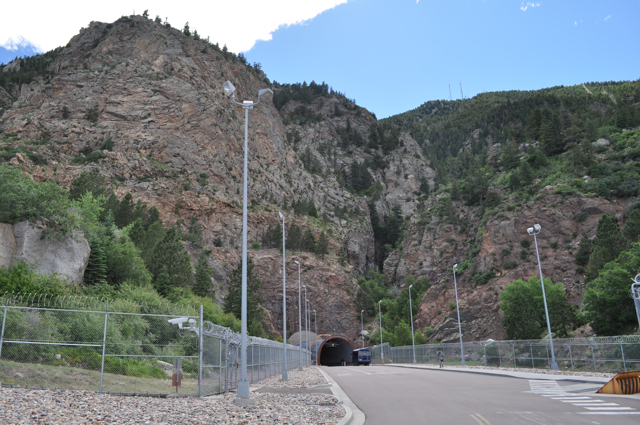
A big part of Faraday’s Mine, the second book in the Emulation Trilogy, will be set in and around Colorado Springs, specifically inside the Cheyenne Mountain Complex.

Despite the fact that Colorado Springs is only four and a half hours from Steamboat, I had never been there. So this weekend I remedied that. Unfortunately there’s no way to get inside (at least if you want to live to tell the tale), but I did get quite close – housing estates now come within two hundred yards of the entrance (good thing the Cold War is over because this would have been the first place the Soviets would nuke) – and I did get a great sense of  the surrounding area, which will also be important to the story.

Writing Tools

One of the challenges I faced in writing Newton’s Ark was tracking several parallel story lines until such time as they all came together towards the end of the book. At the time the only tool I had at my disposal was Microsoft Word and its Outline view. It got the job done but it was a struggle, like driving a screw with pliers. You can do it, but why would you when there’s this thing called a screwdriver?

Soon after I began on the sequel, Faraday’s Mine, I realized I was going to have the same problem, only more so. Not only did I need to keep the story line straight, but it had to be consistent with what had already happened in the first book. And I wanted to raise the intrigue a level, making the web even more tangled.

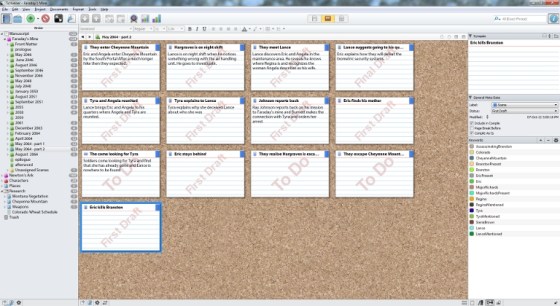
Fortunately I discovered a wonderful program called Scrivener which allows me to organize the book into chapters and scenes using the metaphor of index cards on a cork board. Now I can easily create the structure of the story and then change it on the fly. I can attach notes to each scene to remind myself what I plan to write as well as attaching keywords for characters and locations to each of the scenes so I can see who is doing what to whom and where.

Here’s a look at one of the chapters. If you look real close you might just be able to figure out what is going to happen (warning spoilers – assuming I don’t change it or I’m not just playing with you).
It has turned out to be one of those tools I didn’t know I needed until I found it. Now I couldn’t imagine writing another novel without it.

This post brought to you by author, D.A.Hill.